Brands, be transparent: in the age of AI, trust is not optional

by

5 min for reading

Generative AI in communication: why transparency is now essential

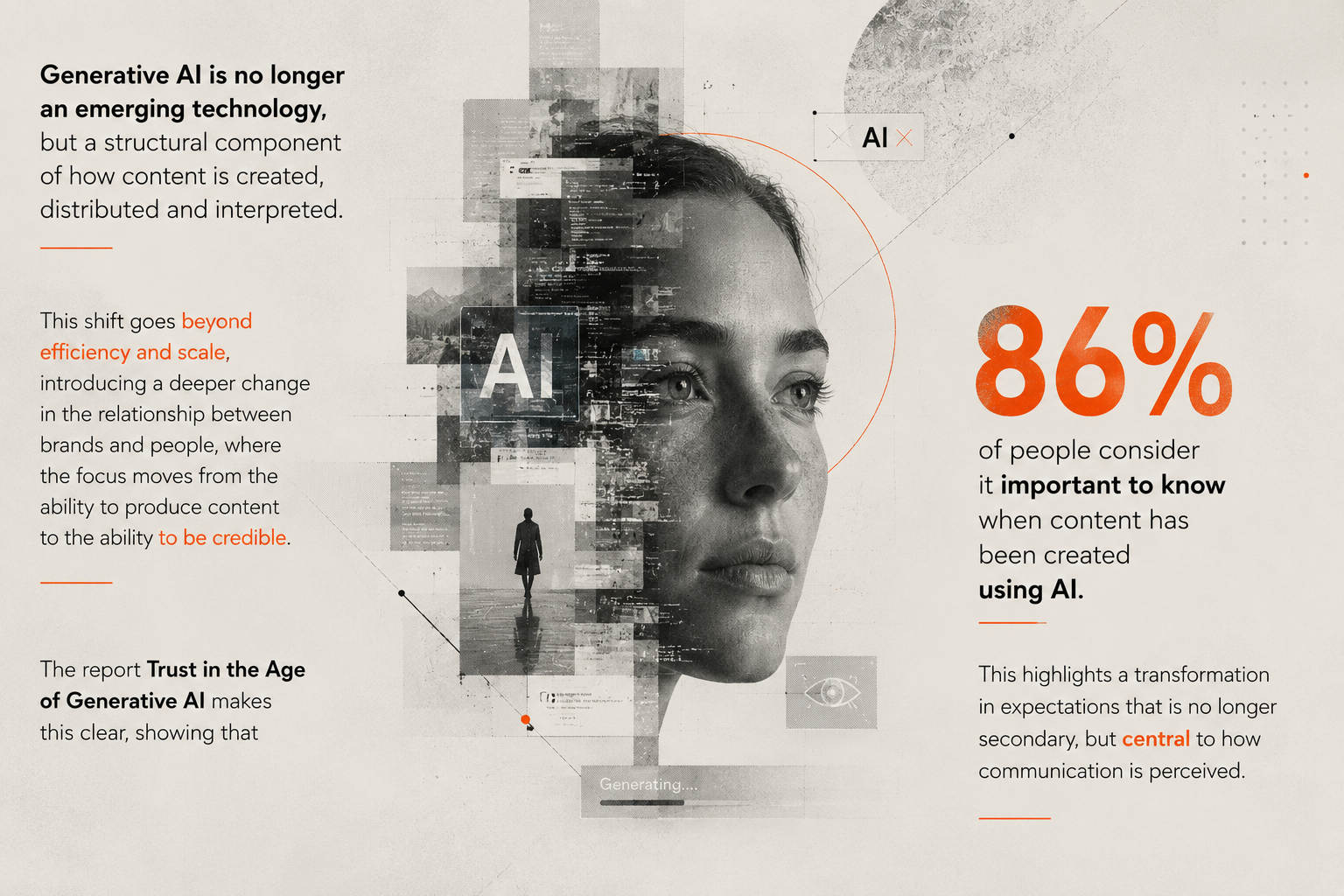
Generative AI is no longer an emerging technology, but a structural component of how content is created, distributed and interpreted. This shift goes beyond efficiency and scale, introducing a deeper change in the relationship between brands and people, where the focus moves from the ability to produce content to the ability to be credible. The report Trust in the Age of Generative AI makes this clear, showing that 86% of people consider it important to know when content has been created using AI, highlighting a transformation in expectations that is no longer secondary, but central to how communication is perceived.

Trust and AI: risk, perception and credibility at stake

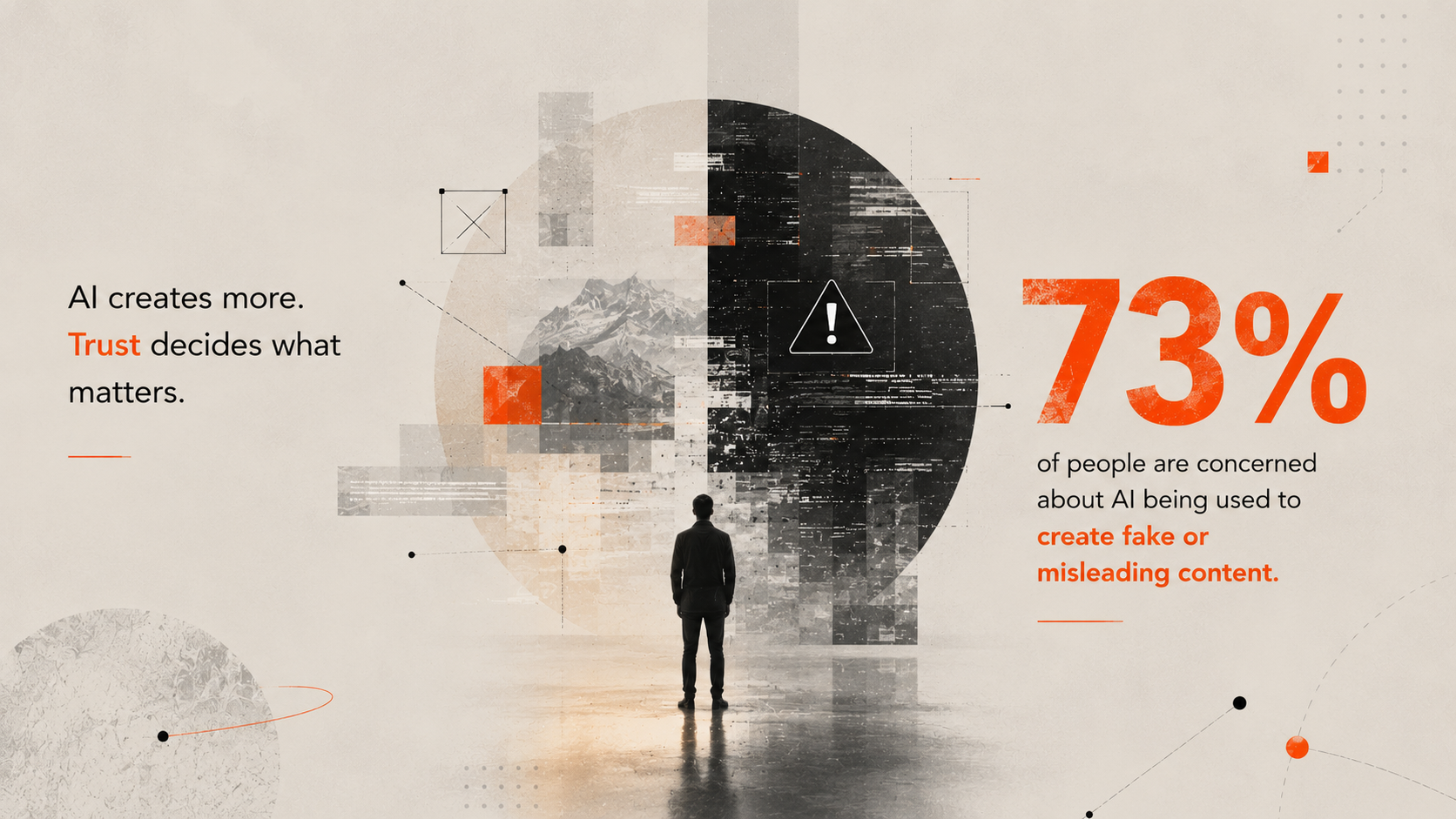
This landscape is defined by a clear tension between opportunity and risk. On one side, AI enables speed, accessibility and continuous production; on the other, it introduces uncertainty around authenticity, accuracy and the distinction between real and generated content. It is not surprising that 73% of people are concerned about AI being used to create fake or misleading content, while 69% worry about the spread of inaccurate information . Within this balance, content is no longer evaluated only for what it says, but for what it represents in terms of reliability, and any ambiguity becomes a potential breaking point in the relationship with audiences.

AI and brand trust: why AI-generated content can reduce trust

Trust, in this context, becomes both measurable and fragile. The report shows that 32% of people say they would trust a brand less if they knew its content had been generated using AI, while only a small minority report increased trust . Even more relevant is the fact that trust declines significantly when content feels misleading or when AI usage is not disclosed, indicating that transparency is no longer a reputational choice, but an implicit requirement. In this sense, AI is not neutral; it amplifies both the value of communication and the risk of undermining credibility.

AI perception: confident users, uncertain environments

The picture becomes more complex when looking at how people perceive their own ability to navigate this environment. While 58% believe they can identify AI-generated content, 87% are concerned that, in general, people will struggle to distinguish what is real from what is generated . This apparent contradiction reflects a broader condition of uncertainty, where confidence does not translate into clarity. At the same time, acceptance of AI varies significantly by context, with higher tolerance in areas such as entertainment and advertising, and much lower acceptance in contexts where credibility is critical, such as news and political communication .

AI strategy for brands: transparency, context and credibility

From a strategic perspective, this defines a clear direction. Brands are not being asked whether to use AI, but how to integrate it within a communication system that remains legible, coherent and trustworthy. Transparency, in this context, is not a limitation, but an essential infrastructure for building trust in an environment where trust is no longer guaranteed. For those working in communication, this implies a shift in approach: moving from producing content more efficiently to designing experiences that maintain a clear balance between technology and human presence, avoiding any ambiguity that could compromise the relationship with audiences. In an ecosystem where everything can be generated, the differentiator will not be the ability to use AI, but the ability to do so without losing credibility.

Riccardo Setth

Learn more

I’m Riccardo Setth, a Digital Project Manager with over 10 years of experience in communication. I work across social, digital content and integrated projects, helping ideas move from brief to execution with clarity, consistency and purpose. My role is to connect people, needs and outputs, making sure every project keeps its direction without losing its creative energy.

You might also be interested in:

There’s a fundamental difference between showing up in a feed and being part of a conversation. The first interrupts; the second participates. That difference defines how brands connect with people today.

The picture is clear. Most users are no longer posting; they’re watching, scrolling, consuming. Content production has consolidated into the hands of a smaller group of increasingly professional creators, while the broader user base has shifted into a passive role.

Every year, TikTok releases what looks like a simple creator ranking. It’s not. The Discover List includes 50 global creators across five categories: Educators, Foodies, Icons, Innovators, and Originators.