Teleport to Topic
Visualizza questo post su Instagram
When the Quarter Won Over the Vision
To understand where surprise went, we first need to understand where power went. With very few exceptions, today’s major fashion brands no longer belong to their founders, the families who built them, or the designers who shaped their creative language. They belong to publicly listed luxury groups that answer to shareholders every quarter with results that must be measurable, comparable, and defensible.
In that environment, creative risk—the real kind, the kind that can fail spectacularly before becoming iconic—has no KPI. It doesn’t fit into a business plan, nor does it make for an easy boardroom presentation, even though those have increasingly become the metrics by which success is judged.
One publication that has consistently articulated this argument, with a level of clarity rarely found in mainstream fashion discourse, is the Italian magazine Rivista Studio. Time and again, it has made the same point: the industry is no longer made up of family-owned brands guided by long-term vision, but of corporate groups whose primary responsibility is to satisfy markets and investors.
And when profit dictates the creative calendar, the first thing to disappear is precisely what made fashion culturally relevant in the first place: creativity itself—the unexpected gesture, expensive, gloriously unnecessary, and made without any guarantee of return.

The system is no longer built on family-owned brands, but on corporate conglomerates driven by profit and accountable to the market. When profit dictates the creative calendar, the first thing to disappear is exactly that: creativity, the unexpected gesture, costly, beautifully unnecessary, and made without any guarantee of return. The system is no longer built on family-owned brands, but on corporate conglomerates driven by profit and accountable to the market.
When profit dictates the creative calendar,
the first thing to disappear is exactly that:
creativity, the unexpected gesture, costly,
beautifully unnecessary, and made
without any guarantee of return.
How COVID Changed Consumer Desire—and Why Brands Were Too Slow to Notice
But reality is always more complex than it first appears, and fashion has always been a reflection of its time. There is another factor the industry has struggled to absorb—one that has quietly but systematically deepened the current creative crisis.
The pandemic, unfortunately, did more than force thousands of stores to close and accelerate the shift to online shopping. It fundamentally changed the way people relate to objects, desire, and spending. Consumption became more intentional, more selective, and less impulsive. Markets contracted, in many countries sharply and for the long term.
As a result, the consumer who emerged from the pandemic is not the same one who entered it. Today’s consumer is more skeptical, better informed, and less willing to pay for the promise of a status symbol that no longer feels authentic.
For the most part, however, the fashion industry’s response was the wrong one. Brands increased the volume of campaigns, collaborations, and product drops. They expanded onto more platforms, partnered with more influencers, and filled more dates on the marketing calendar.
As if the problem were the quantity of visibility rather than the quality of the creative gesture.
The findings of the BoF–McKinsey State of Fashion 2024 report are telling: 68% of consumers say they are overwhelmed by the sheer volume of sponsored content produced by fashion brands, while 65% trust influencers lessthan they did three years ago. Adding to the challenge, Generation Z’s active attention span for advertising drops after just 1.3 seconds.
In short, the evidence suggests this isn’t apathy—it is self-defense against a system that has communicated too much while saying too little.
Saturation no longer seems like a temporary phase. The fashion industry has turned it into the permanent condition in which it operates. And in that condition, surprise becomes structurally impossible, because surprise, by definition, requires contrast—or at the very least, a moment of silence beforehand. Perhaps, in the end, surprise simply requires someone, somewhere, to resist the urge to occupy every available space.
Silence as Both an Answer and a Dead End
The Numbers Behind Fashion's Transformation
Why Surprise Has Become Harder Than Ever
$26M
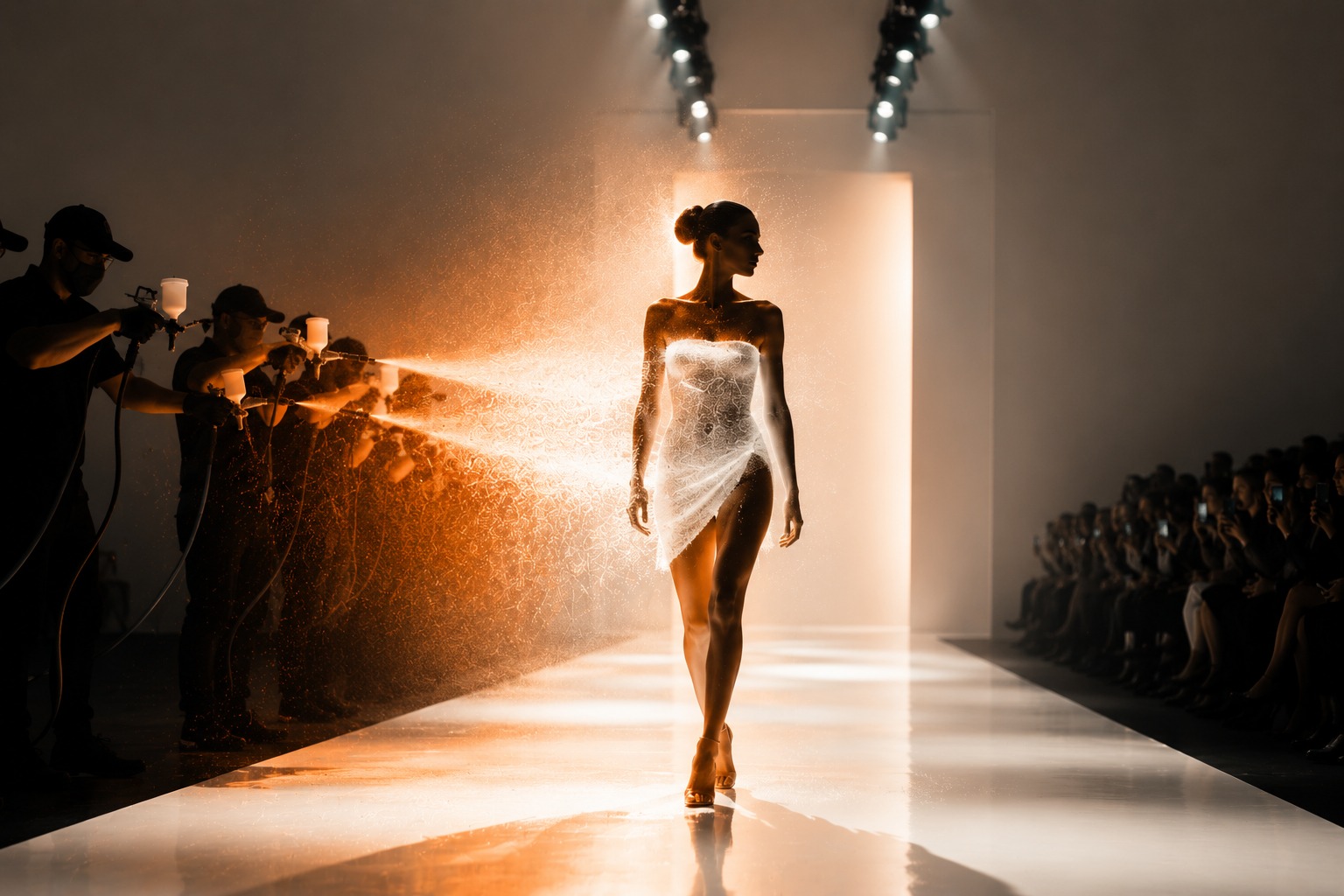
The Media Impact Value generated in just 48 hours by Coperni’s spray-on dress.
68%
Of consumers say they are overwhelmed by the volume of sponsored content from fashion brands.
+614%
Increase in Google searches for “quiet luxury,” turning aesthetic restraint into fashion’s most imitated trend.
The Question the Industry Struggles to Ask
Artificial intelligence will inevitably become part of fashion’s creative process—indeed, in some areas it already has, and in ways that can be genuinely useful and interesting. But AI is ultimately a tool. And tools, by their very nature, amplify the intentions of those who use them.
If the system adopting them has already abandoned risk, patience, bold creative gestures, and the willingness to take a stand, then AI will simply produce those same outcomes more efficiently: form without surprise, execution without a point of view.
The real question the fashion system should be asking is not how to integrate new technology, but whether it still has the courage to hold a real vision worth integrating in the first place.
That evening in Paris, in 2022, someone decided to spray a dress onto a model in front of three hundred people—with no safety net and no certainty of the outcome. It was an expensive gesture, a risky one, and one that could easily have ended in ridicule.
Instead, it became the last moment when the fashion industry—insiders and the general public alike—stopped and watched in genuine amazement.
Technology was present, but it wasn’t the point. What truly mattered was that someone still had a point of view strong enough to bet on it.
AI didn’t take that ability away from us. We lost it ourselves the moment we decided that quarterly results mattered more than vision—and more than values.
Daniela Vignoli
Learn moreI’ve spent over twenty years helping brands figure out not just how to communicate, but what they actually stand for. My background spans fashion, lifestyle and retail — always at the intersection of business strategy, brand identity and organizational culture. Today I work in advisory mode. I’m also co-founder of Edda Studio, an agency dedicated to author marketing and literary positioning.