Teleport to Topic

There was a time when social media was the place where we looked for inspiration for a recipe, a trip, or a new pair of shoes. Today, more and more often, it is also where we try to understand ourselves.
“If you keep procrastinating, you might have ADHD.”
“If this is how you feel in relationships, you may have unresolved trauma.”
“If you recognize yourself in these behaviors, you might be on the autism spectrum.”

Short videos, thousands of comments, and millions of views. Just open TikTok or Instagram and you are immediately faced with content that promises to give a name to our emotions and behaviors.
The point, however, is not to determine whether these videos are right or wrong, but to understand why they work so well. And this is where the phenomenon becomes interesting for anyone working in marketing.
This phenomenon is not the only example of how algorithms influence our behavior. In Supervoice’s recent deep dive on tanmaxxing, we also saw how social media can turn risky practices into viral trends.
The algorithm is not looking for experts. It is looking for attention.
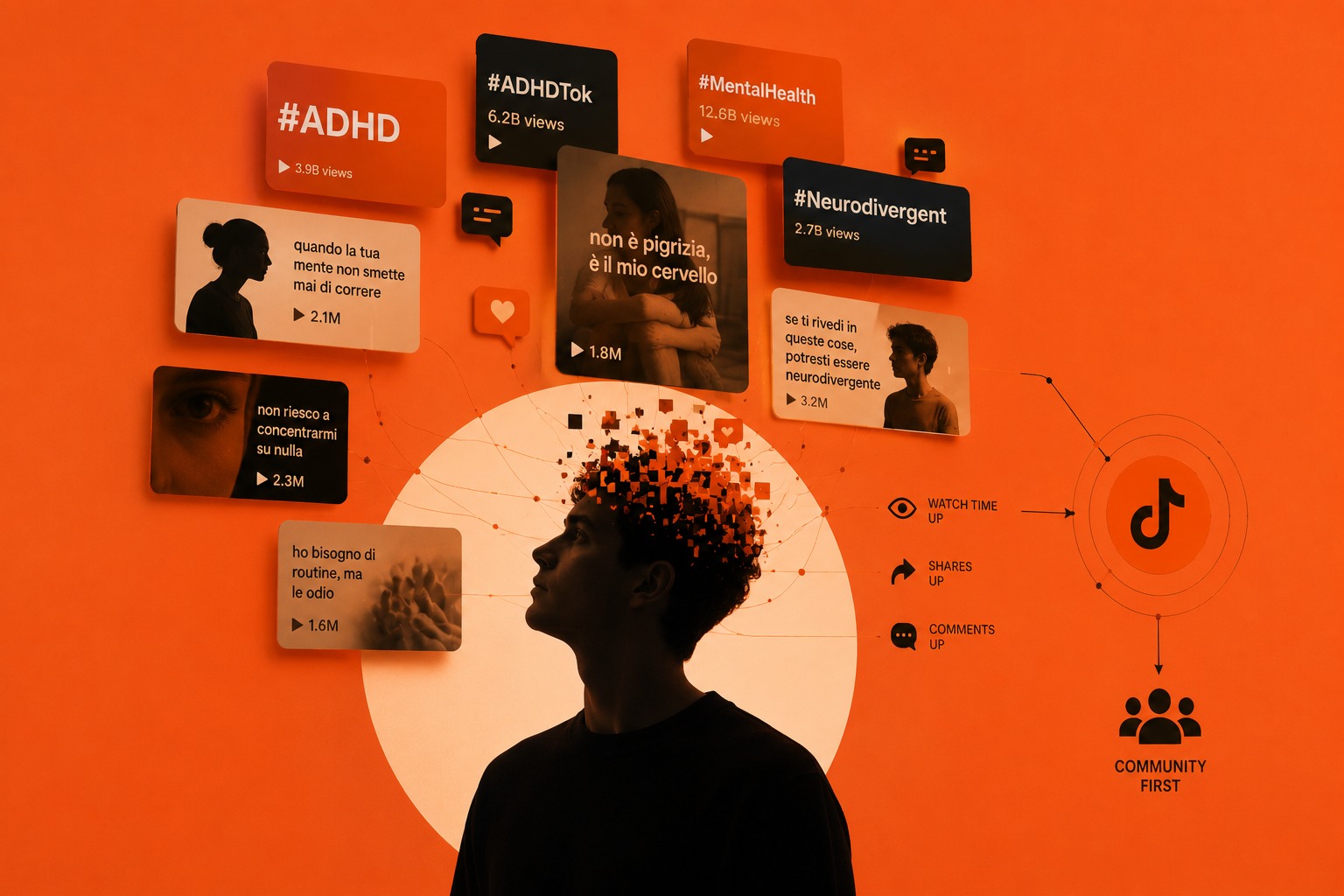
In recent years, hashtags such as #ADHD, #ADHDTok, #MentalHealth, and #Neurodivergent have generated billions of views on TikTok. This is not only a sign of growing awareness around mental health. It also shows how algorithms reward content that is able to create identification.

People who watch this type of content rarely just observe it passively. What makes it go viral is precisely the possibility of recognizing themselves in the experiences being shared.
It is a very powerful dynamic: the more a piece of content makes us think “this is about me,” the more watch time, shares, and comments increase. And these are exactly the signals that the algorithm interprets as valuable content.
Diagnosis, therefore, almost becomes a format.
It is not so different from personality quizzes, digital horoscopes, or “POV” videos. The topic changes, but the lever remains the same: turning a personal experience into a story that millions of people can recognize themselves in.
This is also a principle that emerges from the recent analysis of the TikTok Discover List 2026, where the platform shows that it values creators who are able to build conversations and communities even before simple numbers.
The real issue is not mental health. It is authority.
Social media has made information more accessible than ever. At the same time, it has changed the way we perceive authority.
For years, credibility was mainly linked to titles and institutions. Today, it is also earned through language. That is why a psychologist, a creator, and someone sharing their personal experience can coexist in the same feed and use almost identical formats: strong hooks, storytelling, and videos under one minute.
The difference, however, does not lie in the format, but in the quality of the information.
A review published in recent years highlighted how ADHD-related content on social media has had a positive impact in reducing stigma and increasing awareness, while also encouraging oversimplification and self-diagnosis. This shows just how thin the line is between education and entertainment.

When brands enter the conversation
This scenario is highly relevant for anyone working in communication. For a long time, content marketing tried to explain why one product was better than another. Today, even before explaining, it must be able to create connection.
We see it everywhere: in memes, in “If you also…” videos, in “POV” formats, in User Generated Content, and in creators who tell everyday stories instead of talking directly about the product.
Identification has become one of the main drivers of engagement. But when the topic is mental health, creating connection is not enough. Responsibility is needed.
Some brands have already found an interesting balance.
Dove, for example, has been addressing topics related to self-esteem and body image for years through campaigns developed together with researchers and professionals, avoiding the transformation of psychological well-being into a simple trend. The result is communication that manages to be emotional without losing credibility.
It is probably one of the best case studies in the world on this topic. It talks about the impact of AI on body image and reaffirms Dove’s commitment not to use AI to alter women’s bodies. In my view, this is why Dove continues to be credible: it does not change its narrative by chasing trends, but interprets new phenomena while staying true to the values it has been communicating for more than twenty years.
Headspace has also built its identity by making mental health accessible without trivializing it. Beyond its meditation app, the brand publishes articles, videos, and educational content every day on anxiety, stress, self-esteem, and mindfulness, using simple language and a clean visual design.
On its social channels, it alternates short informative pieces, practical exercises, and deeper content, always inviting users to consider mental well-being as an ongoing journey rather than an immediate solution.
In my opinion, this is precisely Headspace’s strength: it shows that communication can adapt to the language of social media without relying on sensationalist headlines or excessive simplification.
Another interesting example is Rare Beauty. Since its launch, the brand founded by Selena Gomez has built its positioning around authenticity, self-acceptance, and mental health. It does not simply publish content on the topic: through the Rare Impact Fund, it donates 1% of sales to support mental health services and programs for young people, and it relies on a Mental Health Council made up of psychologists, psychiatrists, and experts who guide the project’s strategy. It is an approach that, in my view, works because the brand’s purpose is supported by concrete and consistent actions over time, preventing mental health from becoming just another topic to leverage when it is trending.
An interesting Italian example is Unobravo. As a platform that connects people with psychologists, mental health is at the core of its business. What stands out, however, is the way the brand has chosen to communicate it: on social media, it uses simple language made up of reels, carousels, and easily shareable content, without ever reducing psychological well-being to a list of symptoms or to self-diagnosis. Each piece of content invites people to learn more, contextualizes the topics it addresses, and reminds users of the importance of speaking with qualified professionals. In my view, it is an effective example of how social media codes can be used without sacrificing authority: simplicity becomes a tool to bring people closer to a complex topic, not to trivialize it.
Angelini Pharma has taken a different approach. In recent years, the company has chosen to invest in mental health awareness through the international project Headway – A New Way of Thinking About Mental Health. More than a communication campaign, it is a platform that involves institutions, associations, healthcare professionals, and patients, with the goal of increasing awareness around the topic and promoting more effective policies. I find this choice interesting because it shifts the focus from the product to the construction of a public debate: the brand does not try to insert itself into an existing conversation, but creates a space for dialogue supported by data, research, and partnerships.
It is an example of how communication can generate value when it stems from concrete, long-term commitment rather than from a passing trend.
Looking at these examples, one aspect stands out to me: none of these brands tried to “ride” the mental health conversation. Instead, they chose to build credible positioning over time, supporting their messages with experts, concrete projects, and real investments. I believe this is the difference between a brand that follows a trend and one that builds trust: the first tries to be relevant today, while the second works to remain relevant tomorrow as well. Not by taking audiences away from social media, but by learning how to communicate better within its rules.
Engagement is a metric. Trust is an asset.
It is easy to think that responsibility lies entirely with algorithms. In reality, the algorithm simply does what it was designed to do: show what captures attention.
The real question concerns those who communicate: how much are we willing to simplify a complex topic in order to gain one more view?
This applies to mental health, but also to nutrition, sustainability, personal finance, and artificial intelligence. Every time a technical topic enters social media, the risk is the same: sacrificing context in favor of virality.
For brands, then, the challenge is not to jump on every conversation, but to understand which conversations truly deserve to be owned.
Communicating also means choosing what not to simplify
Viral diagnoses are probably just one of many examples of how algorithms are changing the way we inform ourselves. They remind us that today people look for content they can recognize themselves in even before they look for content they can learn from.
For this reason, brands will continue to invest in identification, storytelling, and creators.
But in a context where everyone is competing for the same few seconds of attention, the real difference will not be made by those who shout the loudest. It will be made by those who are able to build trust without giving up complexity.
I believe that today the true competitive advantage for brands is not intercepting every conversation, but carefully choosing which conversations are worth taking part in.
Virality can make a piece of content grow, but trust is what makes a brand grow.
It is no coincidence that in our deep dive “Brand, Be Transparent: In the Age of AI, Trust Is Not Optional,” we also highlighted how credibility is becoming one of the most important assets for building long-lasting relationships with people. And in the long run, that is what truly makes the difference.
Rosy De Maio
Learn moreAccount at Superhumans. I guide projects from strategy to execution, aligning people, timelines, and goals. I bridge the gap between clients and the creative team, helping turn ideas into impactful solutions.
You might also be interested in:

In via Paolo Lomazzo 20 a Milano nasce Superhumans Milan Hub, realizzato insieme a Orsonero Coffee: un luogo in cui agenzia, città, community e lifestyle condividono lo stesso spazio.

Why has fashion stopped surprising us? Not because of AI, but because of a system that prioritizes quarterly results and creative safety over bold ideas. Through the stories of Coperni, Gucci, and the rise of quiet luxury, this article explores how risk and vision have gradually been replaced by communication overload and the pursuit of predictability.