Teleport to Topic
Prevention doesn't generate hype: the social media short circuit of Tanmaxxing
by
8 min for reading

Summer 2026 brings a striking paradox to light. On the one hand, sunscreen has become a staple of daily skincare and brands are investing in star-studded sponsorships. On the other, “tanmaxxing“: the risky social media trend of sunbathing with no protection at all, or using homemade butters and oils, to maximize the tan to show off online.
This short circuit invites reflection. It is the result of a sixty-year evolution in advertising that has progressively linked the sun to aesthetics, ultimately pushing its risks into the background. It is also the result of a digital communication landscape that struggles to find a balance between entertainment and health information on the channels most used by younger generations.
From status symbol to beauty care: 60 years of advertising
Our relationship with tanning has quite literally been written by the media, which over six decades has changed its skin three times.
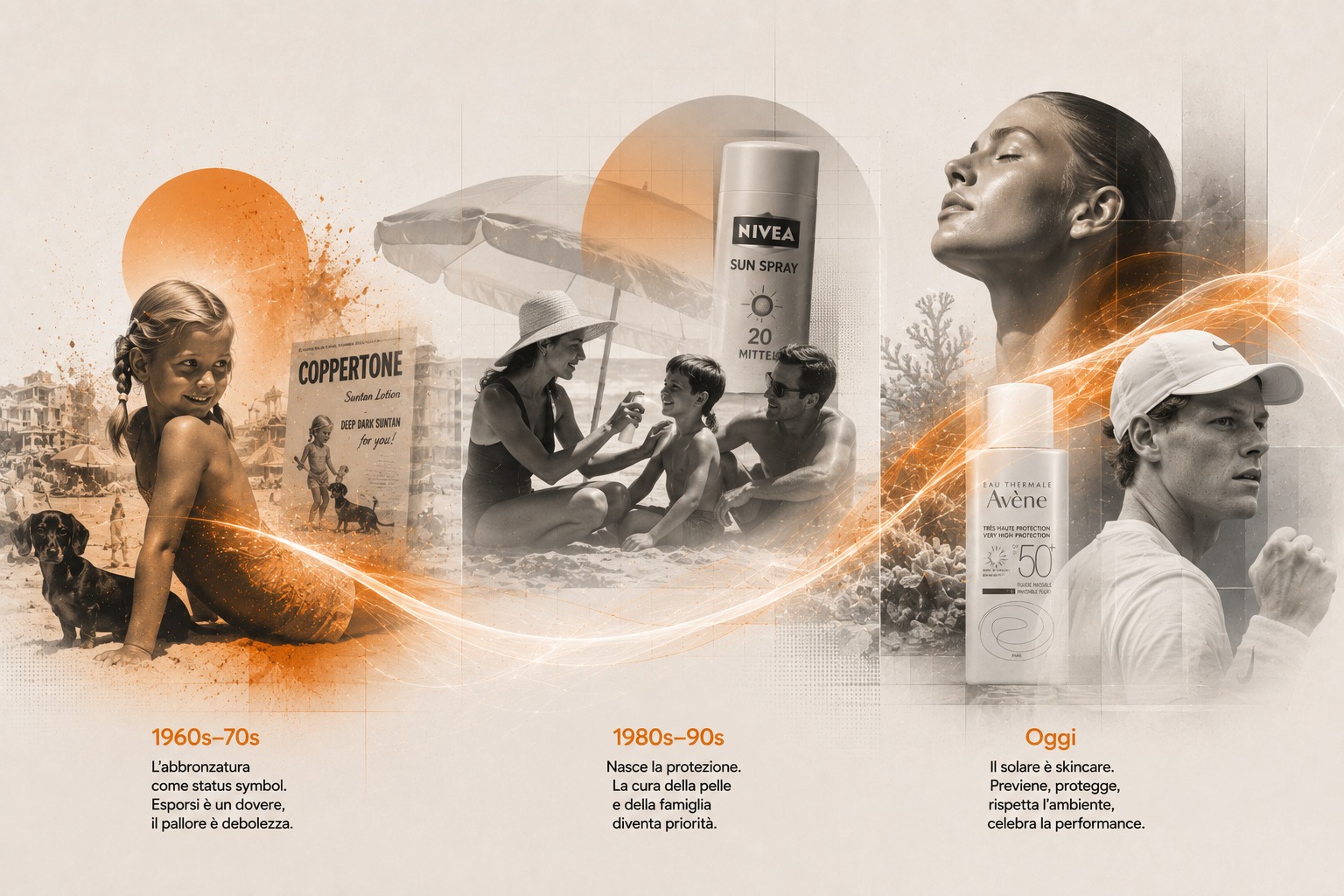
In the 1960s and 1970s, a deep, wild tan was a social duty and a symbol of bourgeois well-being. Ads from the time, such as the famous 1965 Coppertone commercial featuring Jodie Foster, sold oily lotions designed to accelerate colour. Pale skin was the mark of those who had stayed in the city to work.
Between the 1980s and 1990s, as the first dermatological warnings emerged, SPF made its debut: Sun Protection Factor. Communication shifted toward care and family protection, as shown by the 1995 Nivea Sun Spray commercial. The era of dark tanning oils gave way to caution under the beach umbrella.
Today, sun care has become urbanized and integrated into everyday beauty routines. It has become an ally against skin ageing, with a focus on eco-friendly formulas that protect coral reefs, as in the case of Eau Thermale Avène, or connected to global sports icons, as in the La Roche-Posay Anthelios commercial featuring Jannik Sinner, where the concept of health is embodied by the athlete himself.
The tech paradox: the prevention app used to roast in the sun
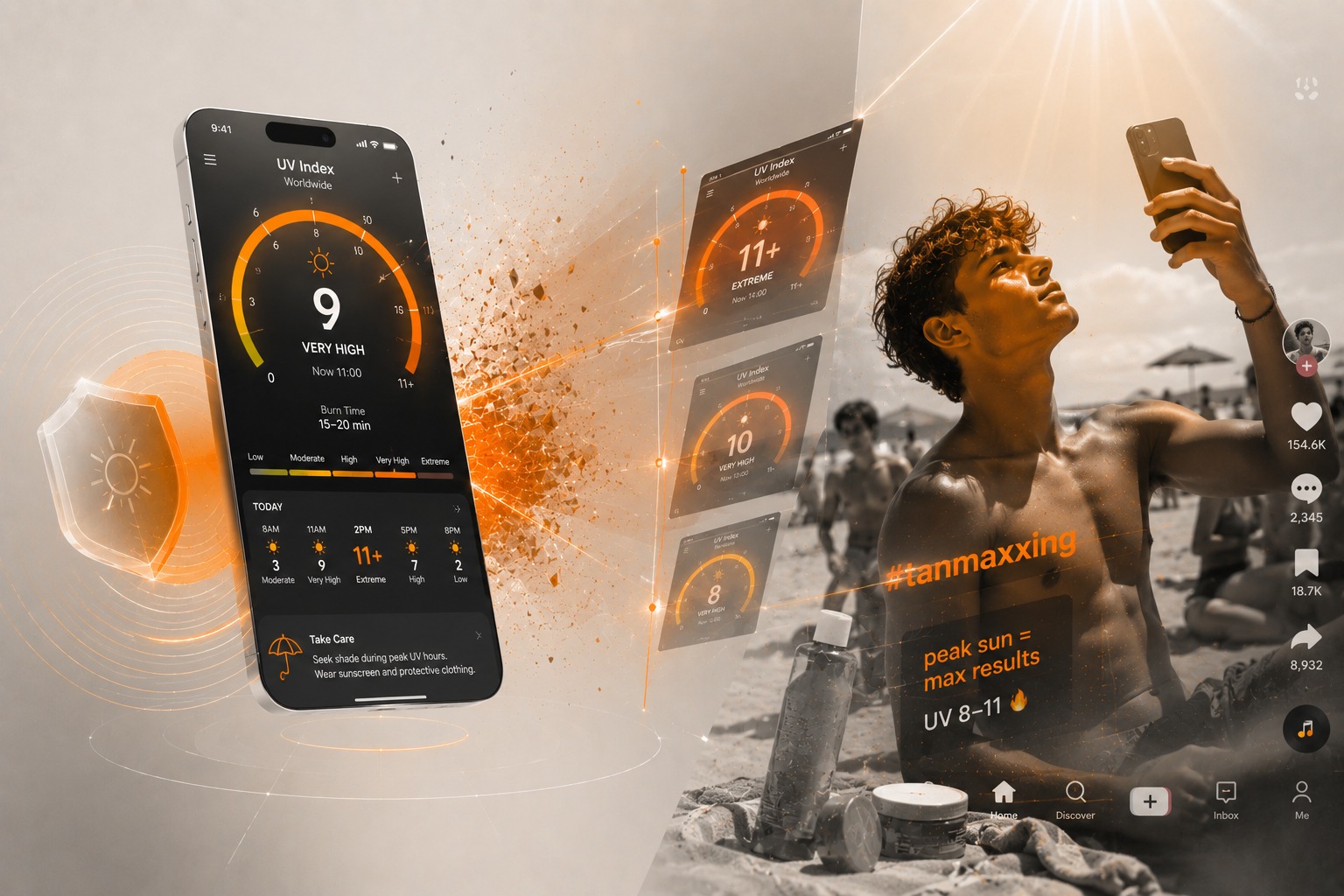
This strong focus on aesthetic and technological aspects has also ended up influencing the way we use digital tools originally created to protect us. This is the case with apps such as UV Index Widget – Worldwide, designed to monitor ultraviolet radiation levels and suggest when to seek shelter.
In many viral videos on TikTok, the logic of tanmaxxing has turned this model upside down. Young people show screenshots of these widgets not to avoid the hottest hours, but to do the exact opposite: identify peak radiation levels, with UV indexes from 8 to 11, and take advantage of that intensity to speed up tanning, reducing or eliminating sunscreen precisely during the most delicate time slots.
The complexity of scientific information on social media
The spread of these trends reveals a deep complexity in modern communication. A recent study from the University of Alberta in Canada, analyzed by Wired, shows that although 86.6% of TikTok videos promote the use of sunscreens, the content focuses mainly on cosmetics, marketing, or wrinkle prevention. The issue of medical prevention and skin cancer remains more marginal, often left to the initiative of individual dermatologists and science communicators. In this context, the rare videos skeptical of sunscreens, around 6% of the total, manage to attract disproportionate attention, as the algorithm tends to reward the most unusual or alarmist claims.
Making prevention a trend, the right one
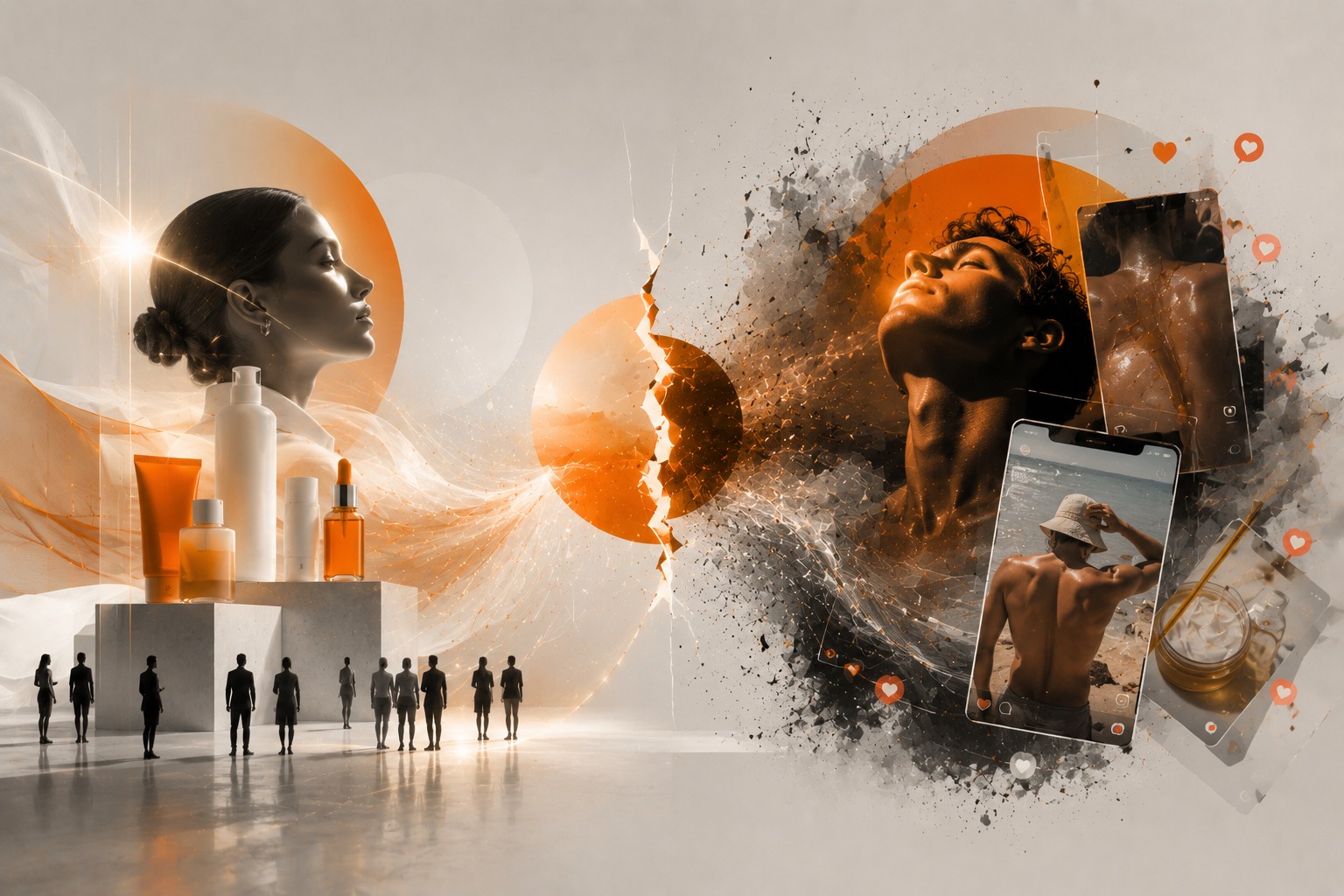
Faced with these dynamics, the need for a change of pace in beauty brand communication becomes clear. Rather than limiting themselves to glossy narratives focused only on aesthetics, brands and social platforms are being called upon to be more attentive and to open up a real dialogue with younger generations. Tanmaxxing clearly shows us that there is a problem of dialogue, and perhaps the key lies precisely in putting ourselves out there and changing the way we speak to young people. One small thought: try to provide real information by combining the voices and expertise of dermatologists with those of talents, using native social formats to create educational content. For example, explaining the basic rules of protection in an ironic and light way, speaking their own language. Some brands have started to do this. However, the messages could also be oriented more clearly toward real prevention, without being afraid of certain words. In the end, showing that you know how to take care of your skin is not uncool, nor is it a limit to aesthetics. Quite the opposite: hype comes from healthy skin, not from a sunburn.
Arianna Barletta
Learn moreArianna Barletta, Account at Superhumans. I shape projects from the initial brief to final delivery, turning needs and ideas into concrete, structured journeys. I coordinate teams and workflows, keeping a constant dialogue with clients and acting as a bridge between the brand’s vision and the agency’s creative energy.
You might also be interested in:

The 2026 World Cup is the perfect opportunity to tap into emotions, cultural identities, and collective rituals. An immense narrative space in which we have explored how brands are trying to win over the heart (and mind) of the audience.
Conversational AI apps are becoming part of our daily lives not only because of what they can do, but because of how they speak to us. From ChatGPT to Claude, Perplexity, DeepSeek, Grok and Gemini, tone of voice is becoming a key factor in how people choose, trust and build relationships with AI assistants.
With generative AI, communication is no longer measured only by speed, but by credibility. People want to know when content is AI-generated, making transparency essential for brands. Today, the real differentiator is not simply using AI, but using it without compromising trust, authenticity, or the relationship with audiences.

The picture is clear. Most users are no longer posting; they’re watching, scrolling, consuming. Content production has consolidated into the hands of a smaller group of increasingly professional creators, while the broader user base has shifted into a passive role.